

There Are Three Sides to Every Story
Most communication breakdowns after 50 aren’t about what you say. They’re about what you assume. In every conversation, there are three versions: what was said, what was heard, and what was meant and the gap between them is where trust, deals, and relationships quietly fall apart.
After 50, most of your communication problems aren’t about skill.
They’re about assumption.
By now, you’ve led teams, closed deals, and navigated your share of tough conversations. You know how to communicate - that’s not the issue. The issue is what happens after you speak.
There are always three sides to every conversation:
What was said.
What was heard.
And what was actually meant.
And the gap between those three? That’s where trust breaks, deals stall, and relationships start to drift.
I saw this play out last year between two business partners I’ve known for years.
Their business was successful and doing well by every measure.
One said, “We need to bring in outside leadership to scale.”
What he meant was “We’ve taken this as far as we can alone. Let’s level up.”
What his partner heard was “You’re not good enough anymore.”
The result… No argument. No blow-up.
But from that moment on, things changed.
Decisions slowed.
Conversations got shorter.
Second-guessing crept in.
One started protecting his position, while the other started questioning the partnership.
And just like that, all their momentum dropped, growth stalled, and exit value took a hit.
Not because of a change in strategy, downturn in the business, or competition - because of interpretation!
This is the trap we must avoid in the 4th Quarter.
We rely on experience.
We shortcut conversations.
We assume alignment.
But experience doesn’t eliminate blind spots - it reinforces them.
You think you’re being clear…
But they think you’re changing the deal.
Remember: Listening isn’t waiting to talk - It’s verifying what landed.
I recommend starting to incorporate things like this in your conversations,
“Let me make sure I’ve got this right…”
“When you say that, what do you mean?”
“Here’s how I’m hearing it…”
They’re simple, but most people skip them because they feel unnecessary. Or worse, inefficient.
They’re not.
In the 4th Quarter, misalignment isn’t a small mistake - it can become a huge liability.
If you’re not checking for understanding, you’re gambling with trust.
And at this stage, trust is the whole game.
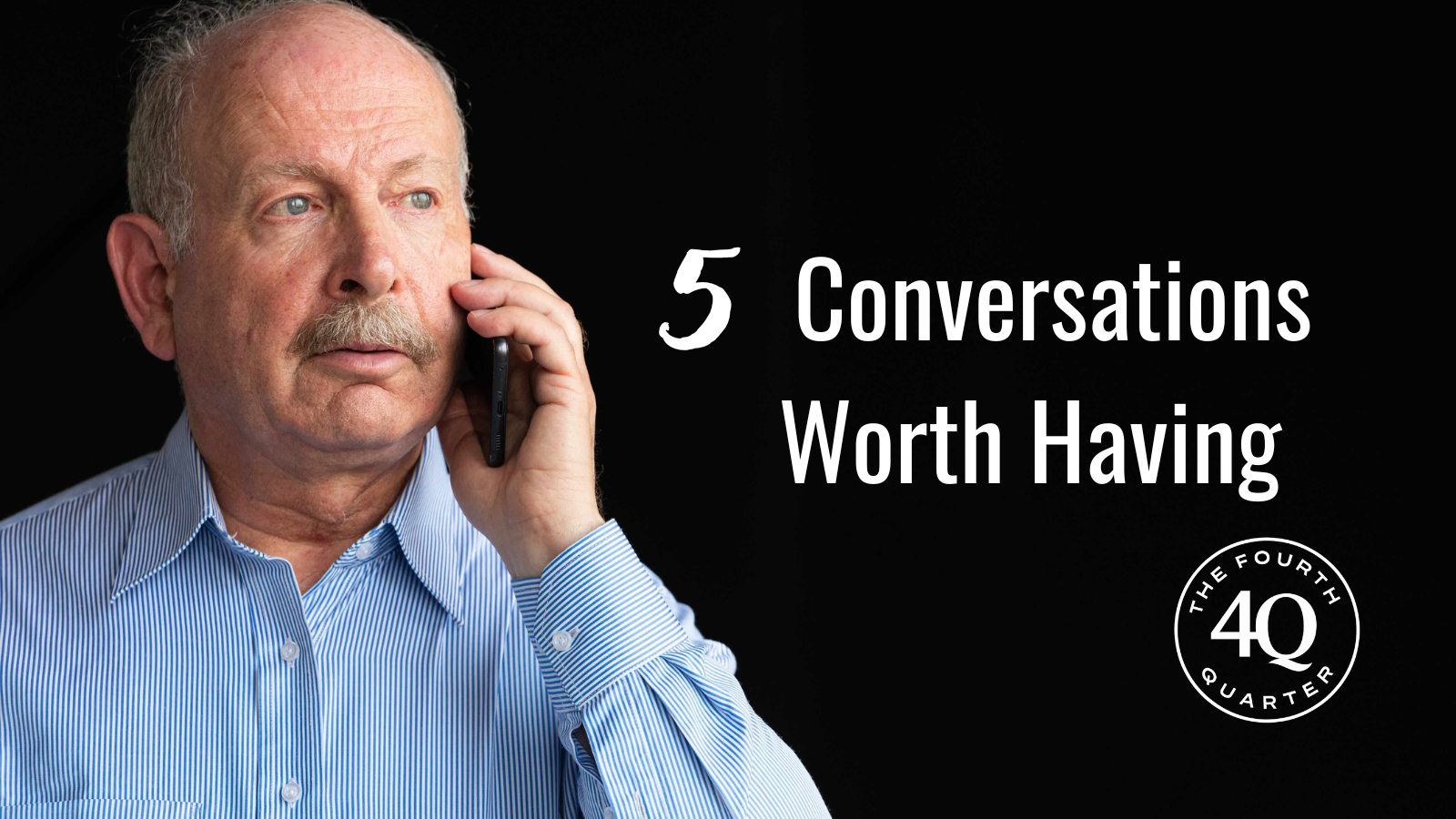
Five Conversations Worth Having Before You Decide What’s Next
Five conversations that can help you gain clarity before deciding what comes next in your 4th Quarter.
When people reach the later stages of their career, the pressure to “figure it out” quietly increases.
What’s next?
What still fits?
What’s worth building now?
The instinct is to retreat inward.
To think harder.
To plan alone.
That’s rarely where clarity comes from.
In the 4th Quarter, some of the most important decisions aren’t made at a desk.
They’re shaped through conversation with people who already know you, understand your context, and aren’t impressed by titles or resumes. Before you commit to a new role, venture, or direction, consider having these five conversations.
Not to get answers, but to gain more perspective
1. The Person Who’s Seen You at Your Best
This is someone who worked closely with you during a strong chapter. They’ve seen how you lead, decide, and handle pressure.
Ask them what they remember you being good at.
Not what you should do, but what they saw you do well.
Patterns tend to surface quickly.
2. The Mentor Who Asks Better Questions Than You Do
Good mentors don’t give instructions. They slow you down.
Reconnecting with someone who’s challenged your thinking before can help you separate genuine desire from temporary restlessness. These conversations often reveal whether you’re chasing change or meaning.
3. The Peer Who Took a Different Path
This is someone roughly your age who made different choices.
Maybe they stayed. Maybe they left. Maybe they reinvented earlier.
Their story isn’t a template to follow.
Instead, it’s a contrast. And contrast often helps clarify.
4. The Person One Chapter Ahead of You
Someone slightly further down the road. They don’t have to be wildly successful, just willing to be honest about their experiences and tradeoffs. These conversations cut through fantasy and replace it with grounded expectation.
5. The Person Who Knows You Outside of Work
This is the friend, partner, or confidant who knows who you are without a role attached. They often notice when you’re misaligned before you do.
None of these conversations requires an agenda or for you to explain a plan.
And none require you to be certain. They help you think more clearly, and more honestly, about what’s next.
In the 4th Quarter, clarity doesn’t come from speed or solitude.
It comes from reflection, dialogue, and perspective.
Before you decide what to build next, talk to people who already know the builder.

Caregiving in the 4th Quarter
In the 4th Quarter, caregiving is not just a burden. It’s part of our legacy.
Here’s the truth: you don’t have to do it alone.
Build a circle of support that includes siblings, friends, and professional resources. Share the load.
Talk about how you are feeling - emotionally and practically.
And remember: someday, those watching us now (our kids, colleagues, and friends) will face their own caregiving journey.
What they see in us today will shape how they handle it tomorrow.
Yes, caregiving is heavy.
But it’s also one of the clearest ways we can prove that legacy isn’t built by what we achieve - it’s built by how we show up, and how we care.
Many of us in the 4th Quarter are being pulled in two directions
Kids growing up and parents growing older.
Some call us the “sandwich generation.”
I call it reality.
Caregiving comes with late-night worries, tough decisions, and more responsibility than we feel ready for.
It can test marriages, strain careers, and drain our energy.
And yet… it also reveals something profound.
It’s a chance to show up with gratitude.
To repay kindness with kindness.
To show our own children what it means to love with patience, even when it’s hard.
In the 4th Quarter, caregiving is not just a burden.
It’s part of our legacy.
The truth is: you don’t have to do it alone.
Build a circle of support, including siblings, friends, and professional resources.
Share the load.
Talk about how you are feeling - emotionally and practically.
And remember that someday, those watching us now (our kids, colleagues, and friends) will face their own caregiving journey.
What they see in us today will shape how they handle it tomorrow.
Yes, caregiving is heavy.
But it’s also one of the clearest ways we can prove that legacy isn’t built by what we achieve - it’s built by how we show up, and how we care.