There Are Three Sides to Every Story
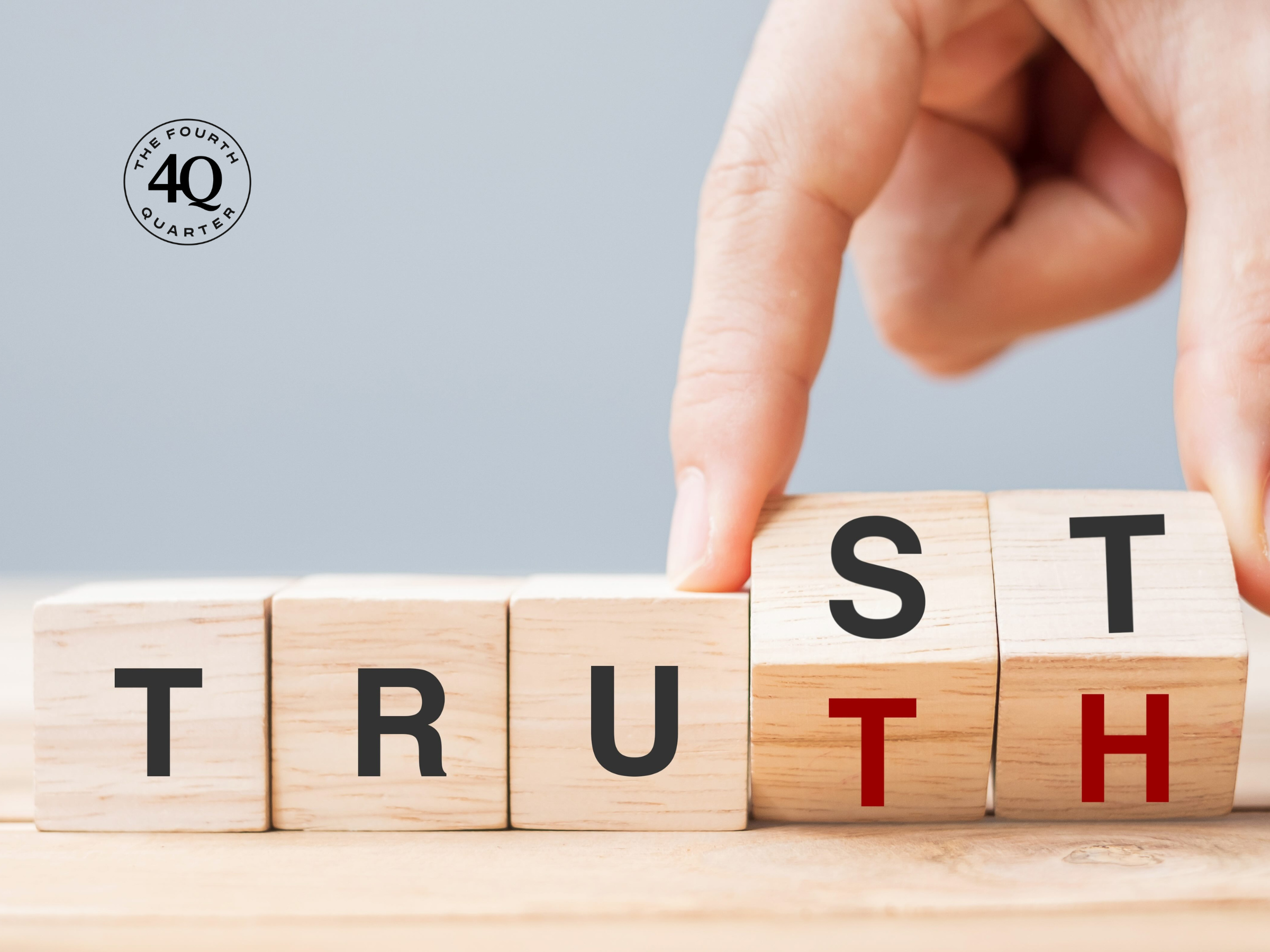
Most communication breakdowns after 50 aren’t about what you say. They’re about what you assume. In every conversation, there are three versions: what was said, what was heard, and what was meant and the gap between them is where trust, deals, and relationships quietly fall apart.
After 50, most of your communication problems aren’t about skill.
They’re about assumption.
By now, you’ve led teams, closed deals, and navigated your share of tough conversations. You know how to communicate - that’s not the issue. The issue is what happens after you speak.
There are always three sides to every conversation:
What was said.
What was heard.
And what was actually meant.
And the gap between those three? That’s where trust breaks, deals stall, and relationships start to drift.
I saw this play out last year between two business partners I’ve known for years.
Their business was successful and doing well by every measure.
One said, “We need to bring in outside leadership to scale.”
What he meant was “We’ve taken this as far as we can alone. Let’s level up.”
What his partner heard was “You’re not good enough anymore.”
The result… No argument. No blow-up.
But from that moment on, things changed.
Decisions slowed.
Conversations got shorter.
Second-guessing crept in.
One started protecting his position, while the other started questioning the partnership.
And just like that, all their momentum dropped, growth stalled, and exit value took a hit.
Not because of a change in strategy, downturn in the business, or competition - because of interpretation!
This is the trap we must avoid in the 4th Quarter.
We rely on experience.
We shortcut conversations.
We assume alignment.
But experience doesn’t eliminate blind spots - it reinforces them.
You think you’re being clear…
But they think you’re changing the deal.
Remember: Listening isn’t waiting to talk - It’s verifying what landed.
I recommend starting to incorporate things like this in your conversations,
“Let me make sure I’ve got this right…”
“When you say that, what do you mean?”
“Here’s how I’m hearing it…”
They’re simple, but most people skip them because they feel unnecessary. Or worse, inefficient.
They’re not.
In the 4th Quarter, misalignment isn’t a small mistake - it can become a huge liability.
If you’re not checking for understanding, you’re gambling with trust.
And at this stage, trust is the whole game.

On Purpose
That’s the difference between living by chance and living on purpose.
And here’s the truth: the 4th Quarter of life doesn’t reward talent or luck. It rewards intention. The pace slows. The details matter.
Experience only helps if you apply it.
So, play the rest of your game on purpose.
Decide what matters.
Try to do it consistently.
When I was younger, I didn’t have to think about much.
I could eat whatever I wanted, stay up late, never stretch, and somehow wake up ready to go again.
Now?
My food can’t be too spicy.
No caffeine after noon.
Bed around 10 PM (for those who know, my day used to start at 10 PM)
Stretching every morning… just to feel normal.
I pay attention to water, sleep, and recovery.
Nothing happens automatically anymore.
In the 4th Quarter, you have to do things on purpose.
At first, that bothered me - it felt like a loss of freedom.
But I’ve learned it’s the opposite.
Doing things on purpose is what gives you freedom.
It’s what keeps you in the game.
Earlier this year, I got a wake-up call. Bell’s Palsy hit me out of nowhere.
Half my face stopped working.
Talking, smiling, and even blinking were affected.
Although it was temporary, it was enough to shake me awake.
I realized that my health, my energy, my abilities - they aren’t guaranteed.
They’re earned. Now, I’m thankful for them.
Every day.
And I protect them, and my overall health.
A Harvard Healthy Aging Study shows that consistent sleep, hydration, and activity don’t just improve health; they improve happiness.
And another study found that people with a clear sense of purpose live longer and function better as they age.
So, I started setting daily goals for myself:
Stretch for ten minutes.
Move. Try for 10,000 steps.
Drink 4L of water (including 1L within 30 mins of waking).
Limit screen time after 9 PM.
Don’t wait to tell people how important they are.
Am I reaching my goals every day?
No.
But I’ll take progress over perfection.
These might sound small, but they build momentum.
You eat better because you want to feel good, not just look good.
You make the call you’ve been putting off because you know it matters.
You keep showing up, even when you don’t feel like it.
That’s the difference between living by chance and living on purpose.
And here’s the truth: the 4th Quarter doesn’t reward talent or luck.
It rewards intention.
The pace slows.
The details matter.
Experience only helps if you apply it.
So, play the rest of your game on purpose.
Decide what matters.
Try to do it consistently.
Let’s play to win.

Sleep Is My New Superpower
“Sleep when you’re dead” is a fast track to getting there sooner. And at 55, I feel no need to speed that up.
In the 4th Quarter, quality sleep isn’t optional.
Sleep-deprived adults don’t just feel tired they increase their risk of heart disease, Alzheimer’s, and early death skyrockets.
And cognition?
Forget it.
You don’t make sharper decisions on less sleep. In fact, most of the time we make worse ones.
For years, I used to say, “I only need four to five hours of sleep.”
When I started my career, I worked five nights/week until 5:00 AM.
(Shout out to The Dome and other bar staff alumni from the 90s who can relate.)
Then it was agency life.
Fewer late nights, but it was hard to shut my brain off, and I would often wake up with ideas.
Then it start-up life and the “Hustle” culture that told us that sleep was for the weak.
That you could grind harder, go longer, and somehow outwork biology.
But here’s the truth: the whole “Sleep when you’re dead” is a fast track to getting there sooner.
And at 55, I feel no need to speed that up.
In the 4th Quarter, quality sleep isn’t optional.
Dr. Matthew Walker, author of the bestseller Why We Sleep, has shown in decades of research that quality sleep is the single greatest lever for memory, recovery, and even mortality. Sleep-deprived adults don’t just feel tired they increase their risk of heart disease, Alzheimer’s, and early death skyrockets.
And cognition?
Forget it.
You don’t make sharper decisions on less sleep.
In fact, most of the time we make worse ones. (Walker interview here)
For me, the shift came when I realized I wasn’t impressing anyone with late nights.
Lately, I’m enjoying getting an early start on the day.
So what can you do to improve the quality of your sleep?
Consistency. Making sleep non-negotiable.
Wind down for 30–60 minutes. Shut the laptop, dim the lights, and read something calming.
Keep a schedule. Go to bed and wake up at the same times. Your body loves rhythm.
Set the stage. A dark, cool, quiet room beats any productivity hack.
In the 4th Quarter, your edge isn’t pulling all-nighters.
It’s showing up with clarity, energy, and presence when others are running on fumes.
Sleep isn’t wasted time.
It could be the most productive thing you can do.
Let’s play to win.

Mobility > Muscle
At 25, it was all about strength and how you looked in the mirror. At 55, it’s about mobility and overall quality of life.
Because what’s the point of big muscles if… Your hips ache, You’re struggling with balance, or you can’t easily get up from the floor or a chair.
At 25, it was all about strength and how you looked in the mirror.
At 55, it’s about mobility and overall quality of life.
Because what’s the point of big muscles if…
Your hips ache,
You’re struggling with balance,
or you can’t easily get up from the floor or a chair.
The key to longevity isn’t moving heavy weights.
It starts with your joints.
The National Institute on Aging emphasizes that flexibility and balance training reduce fall risk, which is one of the leading causes of lost independence as we age (nia.nih.gov).
And once you lose mobility, quality of life takes a nosedive.
Travel gets harder.
Simple things become complicated.
Confidence disappears.
The truth?
If you’re not training for mobility in your 50s, you’re setting yourself up for decline.
Here are a few practical ways to stay active in the game:
Stretch daily. Even 10 minutes matters.
Try yoga or tai chi. Great for flexibility and balance.
Don’t ditch the weights. Strong muscles protect your joints.
Practice balance. Stand on one leg while brushing your teeth.
Let’s be honest.
Mobility training isn’t glamorous.
But I know it’s the difference between sitting on the sidelines watching life and living it fully.
You know the saying, “When is the best time to plant a tree?”
20 years ago. The next best time is today.
If you start now, your 20-year-from-now old ass will thank you.
Let’s play to win.
Your Brain Is a Muscle, Too
Your Brain Is a Muscle Too
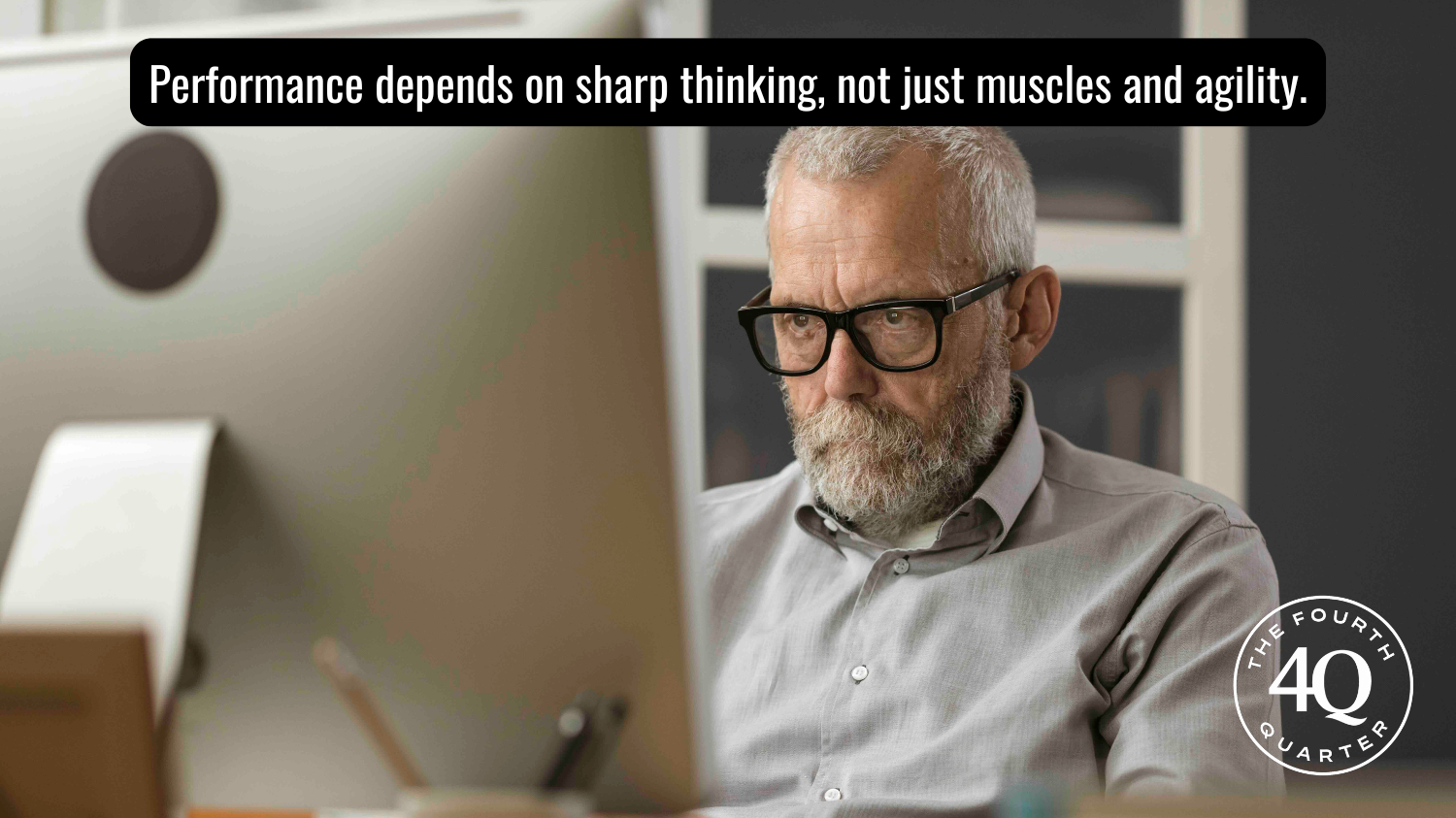
I believe that you’re never too old to press reset. The brain doesn’t just slow down with age. It adapts, strengthens, and even rewires… but only if you challenge it.
In the 4th Quarter, mental sharpness is more than a luxury. It’s essential for performance, leadership, decision-making, relationships, and life choices.
You need your brain to be sharp when problems arise, during negotiations, and when opportunities knock.
I believe that you’re never too old to press reset.
The brain doesn’t just slow down with age.
It adapts, strengthens, and even rewires… but only if you challenge it.
Neuroplasticity research, including a 2024 study in Frontiers in Aging Neuroscience (https://tinyurl.com/3955c4mc), showed that learning new skills throughout life strengthens memory, executive function, and cognitive resilience. The study tracked adults over 60 learning a second language and found measurable improvements in multitasking and attention span.
In the 4th Quarter, mental sharpness is more than a luxury.
It’s essential for performance, leadership, decision-making, relationships, and life choices.
You need your brain to be sharp when problems arise, during negotiations, and when opportunities knock.
Want to stay sharp and give your brain a workout?
Here’s what you can do now:
Take up a new skill you’ve always avoided (language, musical instrument, artistic craft).
Do puzzles regularly (crosswords, logic games, chess).
Switch up your reading material (something outside your comfort zone).
Teach others (mentoring forces you to recall, explain, and stretch yourself).
Look at Warren Buffett, still reading five hours a day in his 90s, sharpening his mind daily. Or Jane Fonda, who reinvented herself (again) in her 70s with a hit Netflix series while still championing activism and fitness. Even the late Maya Angelou kept writing, teaching, and speaking well into her 80s, constantly reinventing and sharing her art and voice.
Age doesn’t stop you from growing.
If anything, it multiplies the returns if you stay in the game.
Let’s play to win.

Food is Fuel. Eat for Energy.
In recent years, it seems like there has been a new diet craze every year promising to melt away fat, build muscle, make you smarter, sexier, and even improve your eyesight. But in the 4th Quarter, your diet isn’t about six-packs, beach bodies, or the next crazy fad.
It’s about fueling focus, energy, and longevity - not vanity.
In recent years, it seems like there has been a new diet craze every year promising to melt away fat, build muscle, make you smarter, sexier, and even improve your eyesight. But in the 4th Quarter, your diet isn’t about six-packs, beach bodies, or the next crazy fad.
It’s about fueling focus, energy, and longevity - not vanity.
A 2023 study of 25,000+ adults found that those who followed a Mediterranean-style diet had a 23% lower risk of death from any cause over 25 years. The benefits came largely from reduced inflammation and improved metabolic health (JAMA Network Open).
But science only matters if it makes it on the plate.
Here are practical ways to turn meals into vitality boosters:
Protein at every meal. Aim for 15–30g of protein, depending on your body weight and activity level. (Mayo Clinic Health System)
Fiber goals: Adults over 50 should aim for about 21g/day (women) and 30g/day (men). (Mayo Clinic)
Cut processed sugars. Minimize added sugars and ultra-processed foods that spike inflammation.
Hydrate first. Start your day with a tall glass of water (with lemon) before caffeine or breakfast.
In the 4th Quarter, every meal is an investment in vitality.
You aren’t chasing trends. You’re choosing fuel and optimizing energy for what matters.
Because without energy, nothing else matters.
Let’s play to win.

Stress is the Silent Killer, but there is a Cure.
Stress is the real killer in midlife.
Not competition. Not the younger crowd. Not even aging itself.
Unchecked stress is what drains your energy, clouds your judgment, and steals years off your life.
The answer isn’t pushing harder. It’s recovery.
Movement. Breathwork. Sleep. Connection.
Recovery isn’t laziness. It’s strategy. And in the 4th Quarter, it’s the difference between running out of gas and playing your best game.
Because without your health, nothing else matters.
Stress.
It’s something we don’t talk about nearly enough.
But here’s the thing. Stress in the 4th Quarter compounds faster.
By the time you’re in your 50s, the stakes feel much higher.
Career, family obligations, finances, aging parents… they all add up.
Less personal time for you.
Less physical activity.
Less sleep.
More time at the desk (or on the couch).
More snacking.
More drivethru.
Then… the weight starts to pile on, you have less energy,
It feels like you are falling behind, running out of time, or you “missed” your shot.
These are ALL signs of chronic stress.
And here’s the danger.
Chronic stress doesn’t just feel bad; it will shorten your life.
The American Psychological Association calls stress a “silent killer,” linking it to heart disease, hypertension, weakened immunity, poor sleep, and depression (APA).
The thing is, stress doesn’t announce itself.
It chips away at your energy, your focus, your vitality.
But here’s the good news: resilience is built in recovery.
Recovery isn’t laziness.
It’s a strategy.
It’s how you make sure your body and brain can keep performing.
Practical recovery habits (backed by research) include:
Move daily. Light exercise reduces stress hormones and boosts mood. Even a 20-minute walk makes a measurable difference.
Breathe. Controlled breathing (box breathing: in for 4, hold for 4, out for 4, hold for 4) activates your parasympathetic nervous system.
Disconnect. Constant inputs keep your nervous system on high alert. Phone-free walks or quiet meals create space for calm.
Prioritize sleep. Poor sleep magnifies stress; consistent, high-quality rest is one of the best recovery tools available.
Connect. Community and relationships buffer stress. Loneliness does the opposite.
The takeaway?
Stress will always exist, but you don’t have to let it consume you.
In the 4th Quarter, recovery is not optional. It’s the key to longevity, clarity, and energy.
Your best years don’t depend on eliminating stress.
They depend on building a life where recovery is non-negotiable.
Because without your health, nothing else matters.
Let’s play to win.