
There Are Three Sides to Every Story
Most communication breakdowns after 50 aren’t about what you say. They’re about what you assume. In every conversation, there are three versions: what was said, what was heard, and what was meant and the gap between them is where trust, deals, and relationships quietly fall apart.
After 50, most of your communication problems aren’t about skill.
They’re about assumption.
By now, you’ve led teams, closed deals, and navigated your share of tough conversations. You know how to communicate - that’s not the issue. The issue is what happens after you speak.
There are always three sides to every conversation:
What was said.
What was heard.
And what was actually meant.
And the gap between those three? That’s where trust breaks, deals stall, and relationships start to drift.
I saw this play out last year between two business partners I’ve known for years.
Their business was successful and doing well by every measure.
One said, “We need to bring in outside leadership to scale.”
What he meant was “We’ve taken this as far as we can alone. Let’s level up.”
What his partner heard was “You’re not good enough anymore.”
The result… No argument. No blow-up.
But from that moment on, things changed.
Decisions slowed.
Conversations got shorter.
Second-guessing crept in.
One started protecting his position, while the other started questioning the partnership.
And just like that, all their momentum dropped, growth stalled, and exit value took a hit.
Not because of a change in strategy, downturn in the business, or competition - because of interpretation!
This is the trap we must avoid in the 4th Quarter.
We rely on experience.
We shortcut conversations.
We assume alignment.
But experience doesn’t eliminate blind spots - it reinforces them.
You think you’re being clear…
But they think you’re changing the deal.
Remember: Listening isn’t waiting to talk - It’s verifying what landed.
I recommend starting to incorporate things like this in your conversations,
“Let me make sure I’ve got this right…”
“When you say that, what do you mean?”
“Here’s how I’m hearing it…”
They’re simple, but most people skip them because they feel unnecessary. Or worse, inefficient.
They’re not.
In the 4th Quarter, misalignment isn’t a small mistake - it can become a huge liability.
If you’re not checking for understanding, you’re gambling with trust.
And at this stage, trust is the whole game.

What Will It Take?
Waiting feels responsible in the 4th Quarter. That’s why it’s so dangerous.
Optionality doesn’t disappear overnight. It erodes quietly. Your health, confidence, networks, relevance, etc. until one day you realize waiting didn’t protect you. It narrowed your options.
Waiting feels responsible in the 4th Quarter.
That’s why it’s so dangerous.
By this point in your life, you’ve learned patience.
You’ve learned restraint.
You’ve learned that not every impulse deserves action.
That’s a strength… Until it isn’t.
Because somewhere along the way, patience quietly starts to masquerade as wisdom. And wisdom becomes the excuse.
“I’m just being thoughtful.”
“I’m not rushing into anything.”
“I’ll make the move when the timing is better.”
Nothing about those statements is obviously wrong.
That’s the problem.
Most people don’t fail to change because they’re reckless or unmotivated.
They fail because nothing is broken enough, yet.
Life is comfortable. Work is tolerable. Health is good. The downside isn’t screaming.
So they wait.
Here’s the uncomfortable truth about the 4th Quarter:
Our optionality shrinks quietly.
Not all at once. Not dramatically. It doesn’t collapse.
It erodes.
Your health doesn’t vanish. It just stops bouncing back as fast.
Your confidence doesn’t disappear. It hesitates longer than it used to.
Your network doesn’t evaporate. It slowly stops opening new doors.
Your relevance doesn’t end. It just takes more effort to maintain.
None of this triggers an alarm.
There’s no moment where someone taps you on the shoulder and says, “That window just closed.”
It simply gets harder to open the same doors that once swung easily.
And so you tell yourself you’re being patient.
But patience only makes sense when something is compounding in your favor.
In the 4th Quarter, the opposite is often true.
Energy doesn’t renew the way it once did.
Not motivation.
Actual energy. Physical, cognitive, emotional.
You still have plenty. But you don’t have unlimited retries.
Optionality works the same way.
The longer you wait to act, the more conditions you quietly add:
I’ll do it when I feel more confident
I’ll do it when things calm down
I’ll do it when I have more certainty
But certainty doesn’t arrive. It never has.
What does arrive is inertia.
And inertia feels safe because it looks like stability. Until one day it doesn’t.
The risk in your 30s was failure.
The risk in your 50s and 60s is regret.
Not dramatic regret. Not the movie-version.
The quiet kind.
The kind that shows up when you realize you tolerated something for too long.
When you recognize you stayed because it was easier than deciding.
When you finally admit that waiting didn’t protect you. It just narrowed your options.
The lie we tell ourselves is that waiting keeps doors open.
It doesn’t.
It keeps you standing in the hallway, convincing yourself you’ll choose later.
The 4th Quarter isn’t about urgency or panic.
It’s about honesty.
Honesty about what’s changing.
Honesty about what’s no longer expanding.
Honesty about what you’re calling patience.
So I’ll ask you the question that matters.
What will it take before you stop needing permission?
No answer required.
Just don’t lie to yourself.

The Risk Isn’t Failure. It’s Being Defined by an Old Version of Yourself.
The real risk in the 4th Quarter isn’t failure. It’s being defined by an old version of yourself. Staying relevant is about expansion, not reinvention.
Most professionals don’t talk about this openly, but they feel it.
Not fear of losing everything.
Not fear of starting over.
A quieter fear: Am I still relevant?
Not in a desperate, trend-chasing way, but in a deeper sense.
Does how the world knows me still reflect who I am, and what I can contribute, now?
This isn’t a new tension, but it becomes sharper later in life.
Early in your career, relevance is assumed. You’re learning, growing, moving.
Over time, success can quietly harden into identity. Titles stick. Stories repeat. Old wins become shorthand.
And if you’re not careful, the world keeps meeting you where you once were… not where you are today.
I saw a video on Instagram on the weekend that I believe captured this perfectly.
https://www.instagram.com/reels/DMVNN_YR6QK/
Two artists who broke out at the same time in the early 1990s.
Both were wildly successful.
Both were recognizable around the world.
One became known for far more than his first chapter.
Music, yes!
But also TV, movies, businesses, investing, children’s content, lifestyle content and reinvention across generations.
For thirty years, different people knew him for different things, depending on when and where they saw him.
The other built a solid life and career, but remains publicly defined by a single early hit.
Nostalgia became his brand.
The first chapter never expanded.
This isn’t a story about talent or money or celebrity.
It’s a story about outlook and a vision of how they saw the world.
One stayed curious and expansive.
The other stayed anchored to what once worked.
That same dynamic plays out quietly in professional life every day.
Staying relevant isn’t about chasing trends or reinventing yourself every few years.
In fact, the idea of “reinvention” often creates unnecessary pressure.
It suggests you must reject who you were to become something new.
In the 4th Quarter, relevance is better understood as expansion.
You don’t abandon your experience.
You build on it.
You allow the story to continue.
Expansion means letting the world know you for more than one chapter.
It means staying engaged with what matters now, even as you bring decades of perspective to the table.
It means refusing to be trapped by your own résumé.
This doesn’t require urgency or panic.
It requires intention.
Staying relevant might look like learning selectively instead of broadly.
Applying hard-earned judgment to new problems.
Sharing an insight, not just history.
Being curious about emerging conversations without needing to master everything.
It’s not about keeping up.
It’s about staying in the game.
The real risk in the 4th Quarter isn’t that you slow down or shift focus.
It’s that you stop expanding how you contribute.
Relevance doesn’t disappear overnight. It fades quietly when curiosity gives way to comfort and identity becomes fixed.
You don’t need to chase youth, trends, or attention.
You don’t need to become someone else.
But you do need to stay connected to the present, to how value is created, where conversations are happening, and how your experience can still be useful.
The goal isn’t to be famous or flashy.
It’s to remain engaged, adaptable, and alive to what’s next.
In the 4th Quarter, relevance isn’t about proving you still have it.
It’s about continuing to add chapters on your own terms.
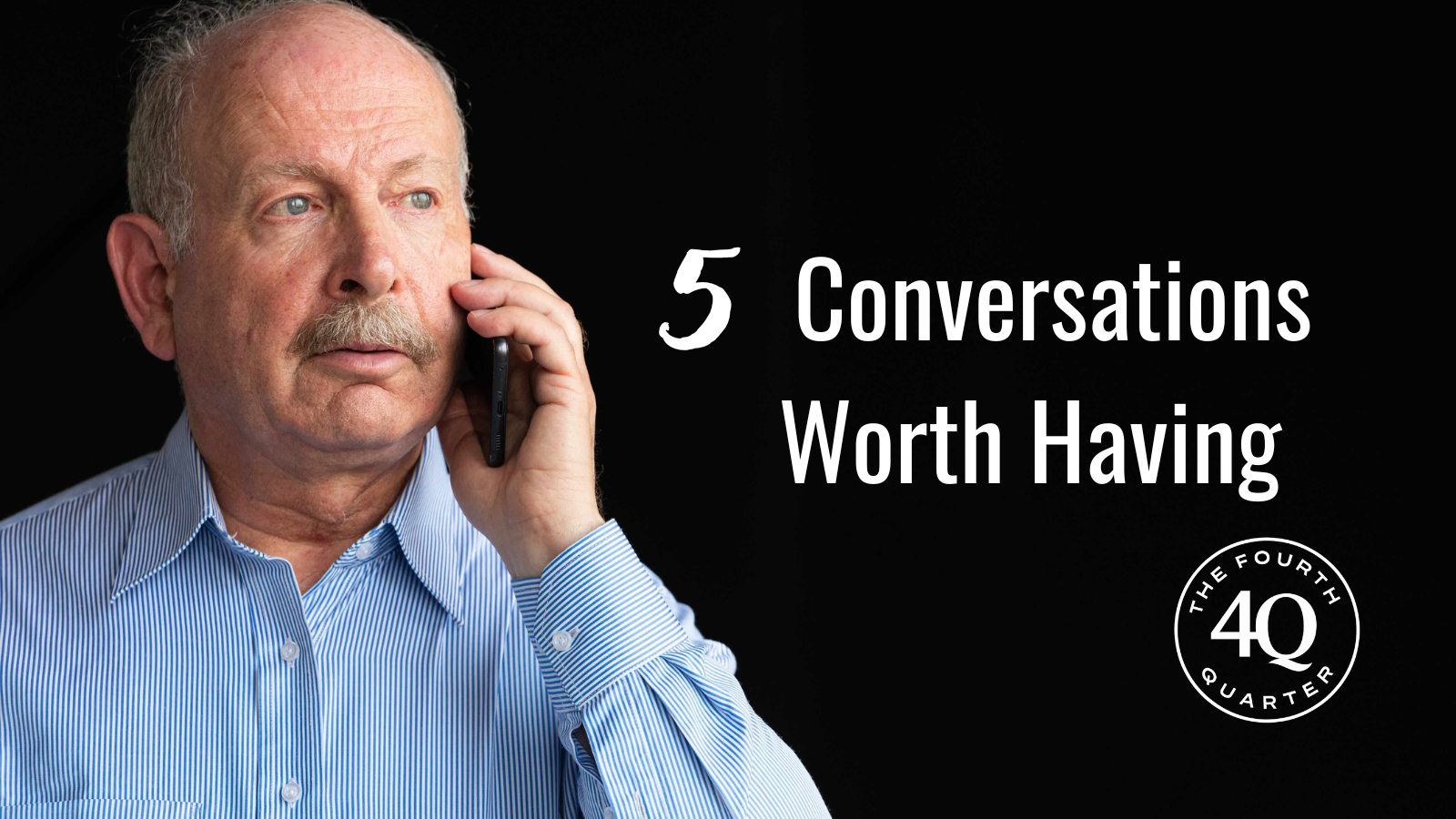
Five Conversations Worth Having Before You Decide What’s Next
Five conversations that can help you gain clarity before deciding what comes next in your 4th Quarter.
When people reach the later stages of their career, the pressure to “figure it out” quietly increases.
What’s next?
What still fits?
What’s worth building now?
The instinct is to retreat inward.
To think harder.
To plan alone.
That’s rarely where clarity comes from.
In the 4th Quarter, some of the most important decisions aren’t made at a desk.
They’re shaped through conversation with people who already know you, understand your context, and aren’t impressed by titles or resumes. Before you commit to a new role, venture, or direction, consider having these five conversations.
Not to get answers, but to gain more perspective
1. The Person Who’s Seen You at Your Best
This is someone who worked closely with you during a strong chapter. They’ve seen how you lead, decide, and handle pressure.
Ask them what they remember you being good at.
Not what you should do, but what they saw you do well.
Patterns tend to surface quickly.
2. The Mentor Who Asks Better Questions Than You Do
Good mentors don’t give instructions. They slow you down.
Reconnecting with someone who’s challenged your thinking before can help you separate genuine desire from temporary restlessness. These conversations often reveal whether you’re chasing change or meaning.
3. The Peer Who Took a Different Path
This is someone roughly your age who made different choices.
Maybe they stayed. Maybe they left. Maybe they reinvented earlier.
Their story isn’t a template to follow.
Instead, it’s a contrast. And contrast often helps clarify.
4. The Person One Chapter Ahead of You
Someone slightly further down the road. They don’t have to be wildly successful, just willing to be honest about their experiences and tradeoffs. These conversations cut through fantasy and replace it with grounded expectation.
5. The Person Who Knows You Outside of Work
This is the friend, partner, or confidant who knows who you are without a role attached. They often notice when you’re misaligned before you do.
None of these conversations requires an agenda or for you to explain a plan.
And none require you to be certain. They help you think more clearly, and more honestly, about what’s next.
In the 4th Quarter, clarity doesn’t come from speed or solitude.
It comes from reflection, dialogue, and perspective.
Before you decide what to build next, talk to people who already know the builder.
The Middle Path: You Don’t Have to Burn It All Down
Reinvention doesn’t require a dramatic leap. The middle path is about designing change with intention, clarity, and optionality.
One of the most persistent myths about 4th Quarter reinvention is that it requires a dramatic leap.
Quit the job.
Burn the boats.
Start over.
Figure it out later.
That makes for a great story, but it’s also misleading and irresponsible.
For many professionals in their 4th Quarter, blowing everything up isn’t courage. It’s an unnecessary risk. And in some cases, it’s a way of avoiding the quieter, more disciplined work that real change actually requires.
There is another option... A middle path.
The middle path isn’t about playing it safe or staying stuck.
It’s about designing the transition, rather than detonating it.
It’s about creating options before urgency, clarity before commitment, and momentum before noise.
This approach recognizes a simple truth: experience changes the equation.
At this stage of life, you’re not starting from zero.
You have skills, relationships, pattern recognition, and perspective.
The question isn’t whether you can start something new.
It’s how to do it in a way that preserves energy, confidence, and optionality.
The middle path might look like testing an idea quietly while you’re still employed.
It might mean taking on advisory work before launching a full venture.
It might involve strengthening relationships, building a runway, or learning a new skill before making anything public.
None of this is flashy. And that’s the point.
A dramatic reinvention is easy to celebrate.
Thoughtful reinvention is harder to see, but far more likely to succeed.
The most effective second acts are rarely built in a single moment.
They’re built through a series of deliberate steps, taken with intention and patience.
Reinvention doesn’t have to be reckless to be real.
Sometimes the strongest move isn’t a leap.
It’s choosing the middle path… and walking it with purpose.

Three Words Instead of Resolutions
I don’t believe in New Year’s resolutions. If you want to change something, quit something, or start something, you don’t need a calendar. Three words can be a better guide.
I’ve never been a big believer in New Year’s resolutions.
If you want to change something, quit something, or start something, you don’t need a date on the calendar to give you permission.
Real change rarely waits for January.
It should start when you recognize something no longer fits.
What has worked for me is a simpler practice: choosing a few words to guide the year.
Not unrealistic goals.
Not hard rules.
Not promises I’ll forget by February.
Just words that act as reference points when my world get noisy.
This year, my three words are:
Flexible.
Physically, mentally, and professionally. Staying loose enough to adapt, recover, and pivot when needed. Flexibility isn’t weakness. It’s range.
Deliberate.
Fewer moves. Better moves. Less reacting, more choosing. At this stage, intent matters more than speed.
Relevant.
Staying curious. Learning new tools. Translating experience into something useful now, not just relying on what worked before.
These words don’t demand perfection.
They help my awareness.
They help me pause and ask, “Is this aligned with how I want to show up this year?”
That’s enough.
The 4th Quarter isn’t about chasing fresh starts or dramatic reinventions.
It’s about making thoughtful adjustments that compound over time.
If you use a similar practice, I’d encourage you to try it this year.
Three words. Flexible meanings. No pressure
From Executive to Entrepreneur
The hardest part of starting something new after 50 isn’t the idea or the money — it’s the identity shift. Learn how experienced leaders move from executive to entrepreneur.
There’s a moment in every late-career transition when the real challenge becomes obvious.
It’s not the business idea.
It’s not the market.
It’s not the risk.
It’s the identity shift.
For decades, our work gave us structure: titles, teams, budgets, goals, reviews, promotions.
We were measured, evaluated, rewarded, and recognized in a system we understood.
Then, if you step out on your own… and the system disappears.
No title to lean on.
No brand behind your name.
No built-in credibility.
Just you. Your judgment, your experience, your reputation, and your willingness to build something from scratch again.
And here’s the truth:
That’s where most 50+ professionals freeze.
Not because they lack ability, but because they’ve never had to see themselves outside the job.
The shift from Executive to Entrepreneur is not about learning new tactics.
It’s about letting go of old definitions.
You stop being the person who manages outcomes.
You become the person who creates them.
You stop being the one who executes a strategy.
You become the one who decides it.
You stop identifying with a role.
You start identifying with a mission.
And here’s the good news:
You’ve already done hard things.
You’ve already led through uncertainty.
You’ve already earned the scars that give entrepreneurs their edge.
You’re not losing an identity. You’re upgrading it.
The 4th Quarter isn’t about stepping down.
It’s about stepping into a version of yourself your younger self wasn’t ready for.
You’re not starting over.
You’re starting from experience.

How to Position Yourself at 50+
When people in their 4th Quarter think about starting something new… whether its a career change by choice (or necessity), becoming a consultant, joining an existing company or becoming an advisor, they usually hit the same wall:
“I don’t know how to position myself.”
It’s not a skills problem.
It’s a packaging problem.
When people in their 4th Quarter think about starting something new… whether it’s a career change by choice (or necessity), becoming a consultant, joining an existing company or becoming an advisor, they usually hit the same wall:
“I don’t know how to position myself.”
It’s not a skills problem.
It’s a packaging problem.
After 25–35 years of experience, your story becomes crowded.
Multiple roles, multiple industries, multiple wins and losses.
And when everything looks relevant… nothing really stands out.
Positioning isn’t about your past.
It’s about understanding what your next “customer” needs from you.
To position yourself as a 50+ founder, you need three things:
1. Your Zone of Genius (credit: Gay Hendricks)
This is the intersection of three realities:
What you’re exceptional at
What energizes you
What others trust you with instantly
Most people over 50 undersell this because they assume everyone can do what they do. They can’t.
2. A Market That Values Maturity
Not every industry rewards experience, but many do.
Areas like B2B services, consulting, operations, compliance, finance, leadership, strategy, and transformation work thrive on wisdom and restraint.
Pick markets where your years are an advantage, not a liability.
3. A Simple, Clear Promise
People don’t buy your résumé.
They buy the potential outcome you can deliver.
“I help X do Y so they can Z.”
Clean. Direct. No confusion.
When you package your experience with clarity, everything else accelerates: opportunities, revenue, confidence, and momentum.
You’re not starting from scratch.
You’re starting from strength.
Now, position yourself like it.
Runway First: Freedom Before Founding
Fear is always loudest before we begin.
It’s the thing that whispers,
“You can’t afford this,” or
“What if it doesn’t work?”
long before you’ve taken a single step.
Fear is always loudest before we begin.
It’s the thing that whispers,
“You can’t afford this,” or
“What if it doesn’t work?” … long before you’ve taken a single step.
The truth is:
Most people don’t fear the work.
They fear the unknown.
They fear the financial guesswork, not the actual numbers.
They fear the possibility of failure, not the real probability.
They fear the story in their head, not the reality in front of them.
Seneca said it two thousand years ago.
“We suffer more in imagination than in reality.”
This is why runway comes first in your 4th Quarter.
Not courage.
Not confidence.
Not the perfect idea.
Your runway is the simple, honest answer to one question:
How long can you build without money pressure crushing your dream?
When you map your expenses, your bridge income, and your time horizon, something powerful happens:
The fear starts to shrink.
The fog clears.
The leap turns into a measured step.
Most people think starting in the 4th Quarter requires bravery.
It doesn’t.
It requires clarity.
And clarity is built with deliberarely, not purely on imagination.
If you’ve been thinking about your next chapter… whether it’s starting a business, launching a consultancy, or joining a new venture; begin with your runway.
This month, I’ll be sharing the 4th Quarter Runway Calculator to help you design that margin with confidence and precision.
Before you found something new, build the freedom to do it well.
Runway first.
Everything else comes second.
The Power of Reverse Mentorship
If you’re thinking about starting something in your 50s or 60s, this is the missing piece: Pair your experience with someone who sees the game differently.
That tension creates innovation.
Don’t hide from the next generation. Partner with them. You can write the next chapter for both of you.
Everyone talks about the importance of mentoring younger professionals.
However, few seem to talk about learning from them.
I believe reverse mentorship is one of the most powerful tools for 4th Quarter professionals:
You bring wisdom, they bring speed.
You bring judgment, they bring experimentation.
You bring pattern recognition, they bring new patterns.
It’s a two-way advantage.
If you’re thinking about starting something in your 50s or 60s, this is the missing piece:
Pair your experience with someone who sees the game differently.
That tension creates innovation.
Don’t hide from the next generation.
Partner with them.
You can write the next chapter for both of you.

Older Founders Win
Being an entrepreneur in the 4th Quarter is not a disadvantage - the research supports it.
I believe we are starting to see the beginning of a new generation of silver entrepreneurs.
The world doesn’t need more 24-year-olds guessing.
It needs more seasoned adults who’ve been in the arena long enough to know what matters.
If you don’t believe me, the data proves it.
For decades, we’ve been fed the myth that entrepreneurship is a young person’s game.
Hoodies, skateboards, energy drinks. Move fast. Break things.
But the numbers tell a different story. A better one, for us.
According to the Kauffman Foundation, MIT, and HBR:
The average successful founder is 45.
Founders over 50 are twice as likely to build a lasting business.
Success rates climb with every decade of experience.
Why?
Because experience compounds.
Because pattern recognition is real.
Because older founders pick better markets, hire better people, and make fewer avoidable mistakes.
Being an entrepreneur in the 4th Quarter is not a disadvantage.
The research supports it.
I believe we are starting to see the beginning of a new generation of silver entrepreneurs.
The world doesn’t need more 24-year-olds guessing.
It needs more seasoned adults who’ve been in the arena long enough to know what matters.
If you’re 50+, don’t ask “Why me?”
Ask “Why not me?”
Not sure?
The data’s on your side.

On Purpose
That’s the difference between living by chance and living on purpose.
And here’s the truth: the 4th Quarter of life doesn’t reward talent or luck. It rewards intention. The pace slows. The details matter.
Experience only helps if you apply it.
So, play the rest of your game on purpose.
Decide what matters.
Try to do it consistently.
When I was younger, I didn’t have to think about much.
I could eat whatever I wanted, stay up late, never stretch, and somehow wake up ready to go again.
Now?
My food can’t be too spicy.
No caffeine after noon.
Bed around 10 PM (for those who know, my day used to start at 10 PM)
Stretching every morning… just to feel normal.
I pay attention to water, sleep, and recovery.
Nothing happens automatically anymore.
In the 4th Quarter, you have to do things on purpose.
At first, that bothered me - it felt like a loss of freedom.
But I’ve learned it’s the opposite.
Doing things on purpose is what gives you freedom.
It’s what keeps you in the game.
Earlier this year, I got a wake-up call. Bell’s Palsy hit me out of nowhere.
Half my face stopped working.
Talking, smiling, and even blinking were affected.
Although it was temporary, it was enough to shake me awake.
I realized that my health, my energy, my abilities - they aren’t guaranteed.
They’re earned. Now, I’m thankful for them.
Every day.
And I protect them, and my overall health.
A Harvard Healthy Aging Study shows that consistent sleep, hydration, and activity don’t just improve health; they improve happiness.
And another study found that people with a clear sense of purpose live longer and function better as they age.
So, I started setting daily goals for myself:
Stretch for ten minutes.
Move. Try for 10,000 steps.
Drink 4L of water (including 1L within 30 mins of waking).
Limit screen time after 9 PM.
Don’t wait to tell people how important they are.
Am I reaching my goals every day?
No.
But I’ll take progress over perfection.
These might sound small, but they build momentum.
You eat better because you want to feel good, not just look good.
You make the call you’ve been putting off because you know it matters.
You keep showing up, even when you don’t feel like it.
That’s the difference between living by chance and living on purpose.
And here’s the truth: the 4th Quarter doesn’t reward talent or luck.
It rewards intention.
The pace slows.
The details matter.
Experience only helps if you apply it.
So, play the rest of your game on purpose.
Decide what matters.
Try to do it consistently.
Let’s play to win.

Caregiving in the 4th Quarter
In the 4th Quarter, caregiving is not just a burden. It’s part of our legacy.
Here’s the truth: you don’t have to do it alone.
Build a circle of support that includes siblings, friends, and professional resources. Share the load.
Talk about how you are feeling - emotionally and practically.
And remember: someday, those watching us now (our kids, colleagues, and friends) will face their own caregiving journey.
What they see in us today will shape how they handle it tomorrow.
Yes, caregiving is heavy.
But it’s also one of the clearest ways we can prove that legacy isn’t built by what we achieve - it’s built by how we show up, and how we care.
Many of us in the 4th Quarter are being pulled in two directions
Kids growing up and parents growing older.
Some call us the “sandwich generation.”
I call it reality.
Caregiving comes with late-night worries, tough decisions, and more responsibility than we feel ready for.
It can test marriages, strain careers, and drain our energy.
And yet… it also reveals something profound.
It’s a chance to show up with gratitude.
To repay kindness with kindness.
To show our own children what it means to love with patience, even when it’s hard.
In the 4th Quarter, caregiving is not just a burden.
It’s part of our legacy.
The truth is: you don’t have to do it alone.
Build a circle of support, including siblings, friends, and professional resources.
Share the load.
Talk about how you are feeling - emotionally and practically.
And remember that someday, those watching us now (our kids, colleagues, and friends) will face their own caregiving journey.
What they see in us today will shape how they handle it tomorrow.
Yes, caregiving is heavy.
But it’s also one of the clearest ways we can prove that legacy isn’t built by what we achieve - it’s built by how we show up, and how we care.

Sleep Is My New Superpower
“Sleep when you’re dead” is a fast track to getting there sooner. And at 55, I feel no need to speed that up.
In the 4th Quarter, quality sleep isn’t optional.
Sleep-deprived adults don’t just feel tired they increase their risk of heart disease, Alzheimer’s, and early death skyrockets.
And cognition?
Forget it.
You don’t make sharper decisions on less sleep. In fact, most of the time we make worse ones.
For years, I used to say, “I only need four to five hours of sleep.”
When I started my career, I worked five nights/week until 5:00 AM.
(Shout out to The Dome and other bar staff alumni from the 90s who can relate.)
Then it was agency life.
Fewer late nights, but it was hard to shut my brain off, and I would often wake up with ideas.
Then it start-up life and the “Hustle” culture that told us that sleep was for the weak.
That you could grind harder, go longer, and somehow outwork biology.
But here’s the truth: the whole “Sleep when you’re dead” is a fast track to getting there sooner.
And at 55, I feel no need to speed that up.
In the 4th Quarter, quality sleep isn’t optional.
Dr. Matthew Walker, author of the bestseller Why We Sleep, has shown in decades of research that quality sleep is the single greatest lever for memory, recovery, and even mortality. Sleep-deprived adults don’t just feel tired they increase their risk of heart disease, Alzheimer’s, and early death skyrockets.
And cognition?
Forget it.
You don’t make sharper decisions on less sleep.
In fact, most of the time we make worse ones. (Walker interview here)
For me, the shift came when I realized I wasn’t impressing anyone with late nights.
Lately, I’m enjoying getting an early start on the day.
So what can you do to improve the quality of your sleep?
Consistency. Making sleep non-negotiable.
Wind down for 30–60 minutes. Shut the laptop, dim the lights, and read something calming.
Keep a schedule. Go to bed and wake up at the same times. Your body loves rhythm.
Set the stage. A dark, cool, quiet room beats any productivity hack.
In the 4th Quarter, your edge isn’t pulling all-nighters.
It’s showing up with clarity, energy, and presence when others are running on fumes.
Sleep isn’t wasted time.
It could be the most productive thing you can do.
Let’s play to win.

Mobility > Muscle
At 25, it was all about strength and how you looked in the mirror. At 55, it’s about mobility and overall quality of life.
Because what’s the point of big muscles if… Your hips ache, You’re struggling with balance, or you can’t easily get up from the floor or a chair.
At 25, it was all about strength and how you looked in the mirror.
At 55, it’s about mobility and overall quality of life.
Because what’s the point of big muscles if…
Your hips ache,
You’re struggling with balance,
or you can’t easily get up from the floor or a chair.
The key to longevity isn’t moving heavy weights.
It starts with your joints.
The National Institute on Aging emphasizes that flexibility and balance training reduce fall risk, which is one of the leading causes of lost independence as we age (nia.nih.gov).
And once you lose mobility, quality of life takes a nosedive.
Travel gets harder.
Simple things become complicated.
Confidence disappears.
The truth?
If you’re not training for mobility in your 50s, you’re setting yourself up for decline.
Here are a few practical ways to stay active in the game:
Stretch daily. Even 10 minutes matters.
Try yoga or tai chi. Great for flexibility and balance.
Don’t ditch the weights. Strong muscles protect your joints.
Practice balance. Stand on one leg while brushing your teeth.
Let’s be honest.
Mobility training isn’t glamorous.
But I know it’s the difference between sitting on the sidelines watching life and living it fully.
You know the saying, “When is the best time to plant a tree?”
20 years ago. The next best time is today.
If you start now, your 20-year-from-now old ass will thank you.
Let’s play to win.
Your Brain Is a Muscle, Too
Your Brain Is a Muscle Too
I believe that you’re never too old to press reset. The brain doesn’t just slow down with age. It adapts, strengthens, and even rewires… but only if you challenge it.
In the 4th Quarter, mental sharpness is more than a luxury. It’s essential for performance, leadership, decision-making, relationships, and life choices.
You need your brain to be sharp when problems arise, during negotiations, and when opportunities knock.
I believe that you’re never too old to press reset.
The brain doesn’t just slow down with age.
It adapts, strengthens, and even rewires… but only if you challenge it.
Neuroplasticity research, including a 2024 study in Frontiers in Aging Neuroscience (https://tinyurl.com/3955c4mc), showed that learning new skills throughout life strengthens memory, executive function, and cognitive resilience. The study tracked adults over 60 learning a second language and found measurable improvements in multitasking and attention span.
In the 4th Quarter, mental sharpness is more than a luxury.
It’s essential for performance, leadership, decision-making, relationships, and life choices.
You need your brain to be sharp when problems arise, during negotiations, and when opportunities knock.
Want to stay sharp and give your brain a workout?
Here’s what you can do now:
Take up a new skill you’ve always avoided (language, musical instrument, artistic craft).
Do puzzles regularly (crosswords, logic games, chess).
Switch up your reading material (something outside your comfort zone).
Teach others (mentoring forces you to recall, explain, and stretch yourself).
Look at Warren Buffett, still reading five hours a day in his 90s, sharpening his mind daily. Or Jane Fonda, who reinvented herself (again) in her 70s with a hit Netflix series while still championing activism and fitness. Even the late Maya Angelou kept writing, teaching, and speaking well into her 80s, constantly reinventing and sharing her art and voice.
Age doesn’t stop you from growing.
If anything, it multiplies the returns if you stay in the game.
Let’s play to win.

Food is Fuel. Eat for Energy.
In recent years, it seems like there has been a new diet craze every year promising to melt away fat, build muscle, make you smarter, sexier, and even improve your eyesight. But in the 4th Quarter, your diet isn’t about six-packs, beach bodies, or the next crazy fad.
It’s about fueling focus, energy, and longevity - not vanity.
In recent years, it seems like there has been a new diet craze every year promising to melt away fat, build muscle, make you smarter, sexier, and even improve your eyesight. But in the 4th Quarter, your diet isn’t about six-packs, beach bodies, or the next crazy fad.
It’s about fueling focus, energy, and longevity - not vanity.
A 2023 study of 25,000+ adults found that those who followed a Mediterranean-style diet had a 23% lower risk of death from any cause over 25 years. The benefits came largely from reduced inflammation and improved metabolic health (JAMA Network Open).
But science only matters if it makes it on the plate.
Here are practical ways to turn meals into vitality boosters:
Protein at every meal. Aim for 15–30g of protein, depending on your body weight and activity level. (Mayo Clinic Health System)
Fiber goals: Adults over 50 should aim for about 21g/day (women) and 30g/day (men). (Mayo Clinic)
Cut processed sugars. Minimize added sugars and ultra-processed foods that spike inflammation.
Hydrate first. Start your day with a tall glass of water (with lemon) before caffeine or breakfast.
In the 4th Quarter, every meal is an investment in vitality.
You aren’t chasing trends. You’re choosing fuel and optimizing energy for what matters.
Because without energy, nothing else matters.
Let’s play to win.

Stress is the Silent Killer, but there is a Cure.
Stress is the real killer in midlife.
Not competition. Not the younger crowd. Not even aging itself.
Unchecked stress is what drains your energy, clouds your judgment, and steals years off your life.
The answer isn’t pushing harder. It’s recovery.
Movement. Breathwork. Sleep. Connection.
Recovery isn’t laziness. It’s strategy. And in the 4th Quarter, it’s the difference between running out of gas and playing your best game.
Because without your health, nothing else matters.
Stress.
It’s something we don’t talk about nearly enough.
But here’s the thing. Stress in the 4th Quarter compounds faster.
By the time you’re in your 50s, the stakes feel much higher.
Career, family obligations, finances, aging parents… they all add up.
Less personal time for you.
Less physical activity.
Less sleep.
More time at the desk (or on the couch).
More snacking.
More drivethru.
Then… the weight starts to pile on, you have less energy,
It feels like you are falling behind, running out of time, or you “missed” your shot.
These are ALL signs of chronic stress.
And here’s the danger.
Chronic stress doesn’t just feel bad; it will shorten your life.
The American Psychological Association calls stress a “silent killer,” linking it to heart disease, hypertension, weakened immunity, poor sleep, and depression (APA).
The thing is, stress doesn’t announce itself.
It chips away at your energy, your focus, your vitality.
But here’s the good news: resilience is built in recovery.
Recovery isn’t laziness.
It’s a strategy.
It’s how you make sure your body and brain can keep performing.
Practical recovery habits (backed by research) include:
Move daily. Light exercise reduces stress hormones and boosts mood. Even a 20-minute walk makes a measurable difference.
Breathe. Controlled breathing (box breathing: in for 4, hold for 4, out for 4, hold for 4) activates your parasympathetic nervous system.
Disconnect. Constant inputs keep your nervous system on high alert. Phone-free walks or quiet meals create space for calm.
Prioritize sleep. Poor sleep magnifies stress; consistent, high-quality rest is one of the best recovery tools available.
Connect. Community and relationships buffer stress. Loneliness does the opposite.
The takeaway?
Stress will always exist, but you don’t have to let it consume you.
In the 4th Quarter, recovery is not optional. It’s the key to longevity, clarity, and energy.
Your best years don’t depend on eliminating stress.
They depend on building a life where recovery is non-negotiable.
Because without your health, nothing else matters.
Let’s play to win.

You Don’t Have to Have an Opinion on Everything
When you choose to have no opinion:
You reduce judgment and start seeing situations more clearly.
You conserve energy for what actually matters.
You protect your peace of mind.
You stay flexible enough to adapt when new facts emerge.
This isn’t about indifference. It’s about focus.
It’s about protecting your mental state, exerting your energy wisely, and reserving your judgment for the people, projects, and priorities that deserve it.
In the 4th Quarter, that kind of clarity is priceless. We don’t need to be everywhere or weigh in on everything.
We need to stay sharp where it counts.
“You always own the option of having no opinion.”
- Marcus Aurelius, Meditations
Those words were written nearly 2,000 years ago, and it is just as relevant today.
Scroll through the news, social media, or even listen to colleagues chatting. Everything today seems to be about provoking a reaction. Spilling the tea, a “hot take”, or a conspiracy theory.
But here’s the truth: you don’t need to form an opinion on every little thing.
You get to decide what deserves your attention, and what doesn’t.
Think about it.
How much time do we waste forming opinions on gossip, politics, or the actions of people we barely know?
How often do we label things as “good” or “bad” when, in reality, they’re just… things?
The power is in realizing that we don’t have to carry all of it.
When you choose to have no opinion:
You reduce judgment and start seeing situations more clearly.
You conserve energy for what actually matters.
You protect your peace of mind.
You stay flexible enough to adapt when new facts emerge.
It isn’t about indifference.
It’s about focus.
It’s about protecting your mental state, exerting your energy wisely, and reserving your judgment for the people, projects, and priorities that deserve it.
In the 4th Quarter, that kind of clarity is priceless.
We don’t need to be everywhere or weigh in on everything.
We need to stay sharp where it counts.
So here’s your reminder: Not everything needs your focus or opinion.
If you want to go deeper, I recommend following Ryan Holiday and picking up his books on Stoicism.
They’re all full of practical wisdom that feels as relevant today as it did in the Roman Empire. My favourite is The Obstacle is the Way.
Turns out, sometimes, the best move is no move at all.
Let’s play to win

Your Personal Brand Is Working Capital
Titles change.
Companies go out of business.
Industries evolve.
But your personal brand?
That’s the one thing you take with you into every chapter of your career.
Think of it as your working capital.
Seth Godin says it’s “the story people tell themselves about you.”
Gary Vaynerchuk calls it “your reputation at scale.”
I say “Your personal brand is how people experience you, remember you, and talk about you when you’re not in the room.”
Titles change.
Companies go out of business.
Industries evolve.
But your personal brand?
That’s the one thing you take with you into every chapter of your career.
Think of it as your working capital.
Seth Godin says it’s “the story people tell themselves about you.”
Gary Vaynerchuk calls it “your reputation at scale.”
I say, “Your personal brand is reputational equity. It’s how people experience you, remember you, and talk about you when you’re not in the room.” And, in the 4th Quarter, it matters more than ever.
Because here’s the reality: when you’re no longer chasing titles, your brand is what keeps doors open. It’s what makes people think of you for a consulting role, a board seat, or a partnership opportunity.
It’s the reason someone calls you instead of the person with the shinier résumé.
Let’s be clear. A personal brand isn’t about creating a false persona.
The strongest brands come from authenticity.
From telling stories rooted in your experience.
From sharing the lessons you’ve lived, not the ones you Googled or AI made up.
So how do you build it?
Share your perspective on LinkedIn or in your industry.
Tell stories that connect your past experience to today’s challenges.
Be generous with your network. That means making introductions, mentoring, and giving without expecting a return.
Keep showing up. Consistently. So people know what you stand for.
Your personal brand is already being built whether you work on it or not.
My question is: Are you being intentional about it?
In the 4th Quarter, it’s not about being the loudest. It’s about being clear, authentic, and visible enough that people know exactly who you are and why you matter.
Titles will change, and Companies will move on.
But your personal brand is yours to protect, grow, and leverage.
And in the 4th Quarter, it might just be your most valuable working capital.
Let’s play to win.